
Patio Ideas for Small Gardens: Layouts That Make Space
How to plan a patio in a small garden so it feels roomy, drains properly and still leaves space for plants.
A small garden asks more of a patio than a large one does. Every square metre has to earn its place, and a poor layout is obvious because there is nowhere to hide it. The good news is that small plots respond well to a handful of simple design decisions, most of which are simple to plan in at the start.
This article looks at patio ideas for small gardens from a practical angle: how to work out what you need the space to do, how slab size and laying pattern change the feel of the area, where seating and planters fit, and how to deal with levels, privacy and drainage without losing all of your planting space.
Decide what the patio has to do first
Before choosing a single slab, write down what you actually do outside. A table for four, a pair of lounge chairs, somewhere to dry washing, a place for the bins, a spot for the children's scooters. Small gardens rarely manage all of these at once, so ranking them stops you building a patio that does everything badly.
Then put the furniture on the lawn or the ground as it will really sit. Use cardboard or chalk to mark the table and the space needed to pull chairs out and walk behind them. Many people find the patio they imagined is a little too small, or the shape wastes a corner that could have held storage or a planting bed. Marking it out takes ten minutes and saves a change of mind later.
Large format slabs make a small area feel calmer
Lots of small paving units and many joint lines can make a compact patio look busy. Larger slabs, such as big rectangles in porcelain or sawn natural stone, give fewer joints and a cleaner, more continuous surface. The eye reads the area as one calm plane rather than a patchwork, and that tends to make the garden feel larger.
There are practical points to weigh up. Big slabs are heavy and need careful handling, a sound sub-base and accurate levels, because any movement shows up clearly across a wide face. Access matters too: if everything has to be carried through the house, the size of slab you can use may be limited. Cutting waste can also be higher in a very small or irregular space, so the layout should be planned around the slab size where possible.
Laying patterns that change how the space reads
Laying direction is one of the most useful design tools you have, and it needs no extra materials. Choose the pattern with the proportions of the garden in mind.
- Straight laying with joints running across the width of a narrow garden makes it feel wider; running them along the length draws the eye to the far end.
- Diagonal laying pulls attention to the corners and can make a square patio feel larger, but it creates more edge cuts and more offcuts to dispose of.
- A single size of slab laid in a simple grid looks tidy and is quicker to lay than a random pattern.
- Mixed size patterns suit larger gardens; in a small one they often look fussy and need careful planning to avoid thin slivers at the edges.
- A contrasting border of setts or a different tone of paving can frame the patio, but keep it narrow so it does not shrink the main area visually.
Colour, finish and light
Light and mid-grey, pale sandstone and soft neutral tones reflect more daylight and make a shaded courtyard feel brighter. Very dark paving can look smart but shows every leaf, water mark and footprint, and in a small space it can absorb light and make the boundary walls feel closer. A matt, slightly textured finish is more forgiving than a polished one and gives better grip when wet.
Think about the surrounding surfaces as well. If the house wall, fence and patio are all the same tone, the garden can look flat. A slightly different tone between patio and boundary, plus some planting in front of the fence, adds depth without taking up much room.
Built-in seating, planters and level changes
In a tight plot, furniture that lives permanently on the patio can eat the floor space. Built-in seating along a boundary, with storage underneath, frees the middle of the patio and gives you somewhere to put cushions and tools out of sight. Built-in planters do a similar job, softening a hard edge and holding plants that would otherwise need a border.
Raised areas can add interest, but in a small garden they need restraint. A single shallow step or a raised corner is usually plenty.
- Build seating and planters on proper foundations, not just on top of the paving, so they do not shift or crack the surface.
- Leave drainage holes or a gravel layer in planter bases so water does not sit against the walls.
- Keep seat depth comfortable and make sure any raised edge has a clear, visible step or contrast so nobody trips.
- Check that planter and seating walls do not block access to drains, manholes or the side gate.
Privacy, drainage and keeping room for plants
Small gardens are often overlooked, so privacy is part of the patio design. Slatted screens, trellis with climbers, or a row of tall pots can give cover where it matters, usually on the side you sit facing. Check fence height rules and any covenants before raising a boundary, and check with your local council if you are unsure.
Drainage deserves attention because a small patio often sits close to the house. The surface should fall gently away from the walls, and the damp proof course must stay visible above the paving. Poor falls leave puddles and green algae. If you are paving most of the garden, consider permeable construction or channels so rainwater is not simply pushed towards the house or a neighbour.
Finally, resist the urge to pave edge to edge. Even a narrow planting strip along one side, or a couple of paving-sized gaps left for planting, softens the space and gives bees, birds and you something to look at. If you would like a second opinion on the layout, we offer a free site visit and quote across Worcester and surrounding Worcestershire towns.
Common questions
How can I make a small patio look bigger?
Use larger slabs with fewer joints, choose a light or mid-toned finish and keep the pattern simple. Running joints across the width of a narrow garden and keeping furniture proportionate also helps the space feel more open.
Is diagonal laying a good idea in a small garden?
It can make a square or short patio feel more dynamic, because the lines lead the eye to the corners. The trade-off is more cutting at the edges, more waste and a little more laying time, so it is worth deciding early.
How much of a small garden should be patio?
There is no fixed rule, as it depends on how you use the garden. Many owners keep enough hard surface for a table and chairs plus a walkway, and leave the rest for planting or a small lawn so the garden does not feel like a yard.
Keep reading
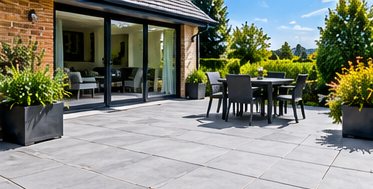
Patio Drainage, Levels and Foundations Explained Simply
Why falls, sub-base and drainage decide whether a patio lasts, plus notes on raised patios, retaining walls and steps.
Read the guide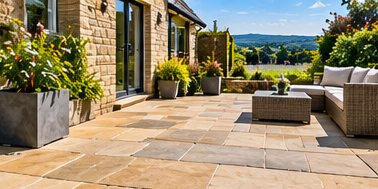
Outdoor Dining and Seating Area Design: A Practical Guide
Plan an outdoor dining and seating area with the right size, shade, lighting, safe fire and BBQ zones and suitable paving.
Read the guide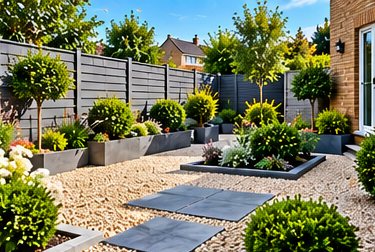
Small Low Maintenance Garden Ideas for Courtyards and Terraces
Ideas for courtyards and terraces that look good through the year with little upkeep, plus honest limits on what low maintenance means.
Read the guidePlanning patios & pathways?
Send a few details and we will arrange a free site visit. Photos on WhatsApp help us understand the job before we visit.
Get a free quote
Tell us a little about the job and we will come back to you shortly.