
Types of Garden Fencing Explained: Styles, Privacy and Upkeep
A plain guide to the main garden fence styles, covering looks, privacy, strength, upkeep and where each one makes sense.
Choosing a garden fence is easier once you know what each style actually does. Some are built for privacy, some for security, some simply mark a line or keep a dog in. A fence that suits a front border may be the wrong choice for a rear boundary beside a busy road, and the reverse is also true.
This guide runs through the common types we are asked to install across Worcester and Worcestershire. For each one we cover the look, how much privacy it gives, how strong it is, what upkeep it needs and where it makes most sense. Heights and boundary rules are covered in a separate article, so here we focus on the styles themselves.
Closeboard and feather edge fencing
Closeboard fencing, also called feather edge fencing, is built on site from tapered boards that overlap one another and are nailed to horizontal rails between posts. Because each board is fixed individually, the fence can follow a slope, step down in height or run around an awkward corner without special panels.
It gives full privacy, is one of the stronger timber options, and individual boards can be replaced if one is damaged. Upkeep means a coat of preservative or stain every so often, and a gravel board along the base keeps the boards out of damp soil. It suits most rear and side boundaries, particularly where you want something solid that lasts and can be repaired. Fixing each board individually also means a damaged one can be swapped without disturbing its neighbours.
Overlap, waney edge and board on board
Overlap panels, sometimes called lap panels, are factory-made frames with thin horizontal strips that overlap. They are quick to fit between posts and give good privacy, but the thin boards and light frames are the least robust option in exposed gardens. Waney edge panels use boards with a natural, wavy edge, giving a rustic look with similar privacy.
Board on board panels have vertical boards fixed with a small overlap on both sides of the rails, so there are no gaps even as the timber shrinks. They are heavier and stronger than basic lap panels, which means the posts and fixings need to be up to the job.
Horizontal slatted, hit and miss and tongue and groove
Horizontal slatted fencing, sometimes sold as Venetian style, is a contemporary look that works well with modern patios and clean-lined planting. Gaps between slats can be small for more privacy or wider for a lighter feel. Hit and miss fencing alternates boards on either side of the rails, so air passes through but you cannot see straight through at an angle. That makes it a sensible choice where wind is a concern, because it lets gusts bleed through rather than pushing against a solid face.
Tongue and groove boards slot together to form a flat, tight surface with no gaps. It looks neat and is very private, though it acts like a sail in the wind, so post depth and spacing matter.
- Horizontal slatted: modern look, privacy depends on slat gaps, needs sound posts and level runs.
- Hit and miss: good airflow, partial see-through at angles, suits exposed plots.
- Tongue and groove: flat and solid, full privacy, takes the most wind load.
- All three need regular preservative or stain, and gravel boards at the base.
Picket, post and rail, and trellis for decorative fencing
Picket fencing has evenly spaced vertical slats and suits front gardens and cottage-style borders. It marks a boundary and looks attractive, but gives little privacy or security. Post and rail fencing is a simple open style with two or three rails between posts. It suits large gardens, paddock edges and places where you want to keep a view, and it can be backed with wire mesh to contain pets.
Trellis or lattice panels are light and decorative. Used alone they give limited privacy, but they are popular as toppers on solid fencing, or to support climbers. Remember a topper can push the overall height over the permitted limit, so check before you add one.
Composite, metal and security fencing
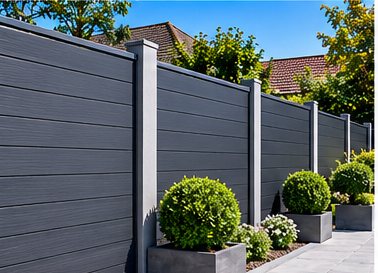
Composite fencing is made from wood fibre and plastic and is sold in boards that slot into posts. It does not need staining, holds its colour better than most timber, and resists rot, though it is not entirely maintenance-free and the panels can be heavy. Our separate article compares composite and timber in more detail.
Metal and aluminium fencing, in steel or aluminium, ranges from slim railings to slatted privacy screens. Steel railings and spiked tops suit security fencing, while powder-coated aluminium slats offer a modern, low-upkeep screen. Metal is strong and holds up well if the coating is intact, but solid-looking metal screens can be heavy, and bare steel needs touching up if the finish is scratched.
Acoustic and natural screening fences
Acoustic garden fencing is built to reduce noise from roads, railways or neighbouring activity. Mass and an airtight build are what count: dense boards, no gaps at the base or between posts, and a heavy construction. It will reduce noise rather than remove it, and a taller, denser fence usually helps more than a thin one.
Willow, hazel, bamboo and reed screening are natural rolls or hurdles that give a soft, informal look. They are quick to put up and suit sheltered spots or as a temporary screen, but they weather faster than timber and are not designed to stop a determined intruder. Treat them as decoration and shelter, not security. Expect to replace or refresh them more often than a timber or composite fence.
Matching the fence to the job
Start by deciding what the fence is for. If privacy and strength matter most, closeboard or board on board is hard to fault. For a modern garden, horizontal slats or composite fit the look. For a front boundary or a dog run, picket or post and rail may be plenty. For noise, an acoustic build matters more than appearance.
Next, think about posts, ground and exposure, along with who will look after the fence afterwards, because a good fence is only as sound as what holds it up. Concrete or timber posts, depth, drainage and slope all affect how a fence behaves. If you would like help choosing, we offer a free site visit and quote, and we handle groundwork, installation and waste removal ourselves.
- Privacy first: closeboard, board on board, tongue and groove.
- Wind exposure: hit and miss or slatted with gaps.
- Low upkeep: composite or powder-coated metal.
- Decorative or front boundary: picket, post and rail, trellis.
- Noise reduction: dense acoustic fencing with no gaps.
Common questions
What is the difference between closeboard and feather edge fencing?
They are two names for the same style. Tapered boards overlap and are nailed to rails between posts, so the fence is built on site rather than arriving as a panel. This makes it easy to adapt to slopes and to repair single boards.
Which type of fence gives the most privacy?
Closeboard, board on board and tongue and groove all give full privacy because there are no see-through gaps. Horizontal slatted fencing can match them if the slats are fitted tightly. Open styles such as picket and post and rail give very little.
Does a taller or denser fence reduce noise?
Usually, yes, because mass and an airtight build are what block sound. Gaps at the base or between boards let noise through, so acoustic fencing is built tight with a gravel board at the bottom. It reduces noise rather than removing it.
Keep reading
Timber or Composite Fencing: Which Lasts Longer in a Garden?
An honest comparison of timber and composite fencing covering rot, staining, fade, wind load, posts and repairs.
Read the guide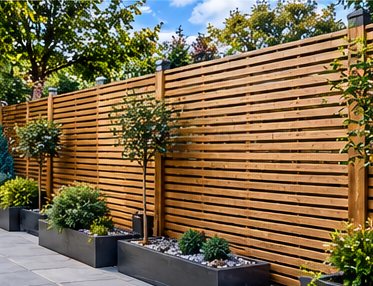
Fence Height and Boundary Rules in England: What to Check First
What to check before fitting or replacing a boundary fence in England: height limits, ownership, neighbours, slopes and access.
Read the guide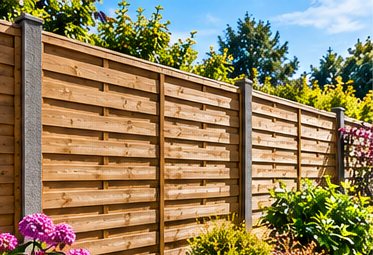
Garden Gates: Types, Fitting, Hardware and Common Repairs
Gate types, openings, posts, hinges, latches and locks, plus why gates sag and how to prepare for automation.
Read the guidePlanning fencing?
Send a few details and we will arrange a free site visit. Photos on WhatsApp help us understand the job before we visit.
Get a free quote
Tell us a little about the job and we will come back to you shortly.