
Privacy Fencing Ideas for Gardens and Neighbours
Ways to screen a garden from neighbours and passers-by, and how to balance privacy, wind, light and good relations next door.
Privacy is rarely just a matter of putting up the tallest fence you can. A solid wall of timber can make a small garden feel boxed in, cast shade across a seating area and take the full force of a winter gale. The better approach is to work out who can see in, from where, and then screen that line of sight specifically.
This article looks at the main privacy fencing ideas for gardens, how they behave in wind and light, and how to combine them with planting, decking and trellis. Fence styles in general and boundary rules have their own articles, so here we concentrate on screening.
Start with the line of sight, not the boundary
Stand where you actually sit, whether that is the patio table, the hot tub or the back step, and look around. You will usually find that overlooking comes from a few directions: an upstairs window next door, a footpath along one side, or a neighbouring garden that sits higher than yours. Screening those lines costs far less effort than enclosing the whole plot.
It also helps to think about time of day. A west-facing seating area that you use in the evening needs different treatment from a vegetable patch you only visit at weekends. Mark the problem points with canes or ask someone to stand at the spot while you check from your chair. A screen only needs to be as long as the view it blocks, and a short, well-placed section often feels far less heavy than a full run.
- Note which windows or paths look into the garden, and at what height.
- Decide which areas need real privacy and which only need softening.
- Check where the sun falls so a new screen does not shade your favourite seat in the garden.
- Consider whether the garden slopes, because a fence on a slope can need to be taller on the low side to do the same job.
Board on board and closeboard for full screening
Board on board fencing overlaps vertical boards so there are no see-through gaps, even when timber shrinks as it dries. It is the traditional choice where you want a solid, quiet-looking boundary, and the overlap gives a slightly more finished face than a basic lapped panel.
The trade-off is wind. A solid fence acts like a sail, so posts, fixings and ground conditions matter a great deal. If your garden is exposed, a solid screen is usually kept to the section that really needs it, with a more open style elsewhere.
Horizontal slats and hit and miss screens
Horizontal slatted fencing has a clean, modern look and works well with contemporary patios and planting. Spaced slats let a little light and air through while still blocking most direct views, particularly if the gaps are narrow. Closer spacing gives more privacy and less movement of air.
Hit and miss fencing alternates boards on either side of the rails, so air can pass through at an angle while the view straight through is largely blocked. That makes it a sensible choice on windy sites, because the fence lets gusts filter through rather than absorbing the full load. It also looks neater from both sides, which neighbours tend to appreciate.
Trellis toppers, hedging and layered planting
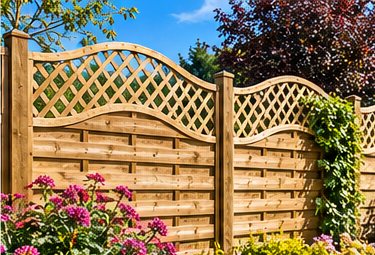
A trellis topper adds a little extra height to a solid fence panel, and the open pattern softens the overall effect. It is also a handy support for climbers such as clematis or honeysuckle, which build up a green screen over a season or two. Always check the overall height against the rules in the final section before ordering.
Hedging combined with fence is a layered option that suits larger gardens. The fence gives immediate cover while the hedge grows, and the planting softens the face of the fence and helps absorb wind and noise. Allow room for the hedge to mature and for you to reach it for trimming, and keep in mind that evergreen hedging takes time to thicken. A mixed hedge of native species also tends to cope with exposed sites better than a single clipped line, and it gives birds somewhere to nest.
- Climbers on trellis give seasonal cover and wildlife value, but need a little tying in each year.
- Evergreen hedges screen all year, though they need regular trimming and some space to grow.
- Deciduous hedges and shrubs thin out in winter, which may not matter if you rarely use the garden then.
- Plant on your own side so growth does not spread over a neighbour's boundary.
Overlooked gardens and raised decking
Raised decking is a common privacy problem. Standing a metre or so above lawn level puts you above a normal fence line, so the fence stops doing its job exactly where you sit. Screening that deck usually means a purpose-built screen fixed to the deck frame or a planted border set back from the edge, rather than simply a taller boundary fence.
For gardens overlooked from above, such as from a bedroom window, a fence alone rarely solves it. A pergola with a slatted roof, a small tree in the right spot or a canopy over the seating area often does more than another row of boards.
Being fair to the neighbours
A tall solid fence has two faces, and one of them belongs to someone else. Talk to the neighbours before work starts: tell them what you plan, which side the posts and rails will face and whether access will be needed to build or maintain it. Boundary ownership depends on your title deeds, so check who is responsible for which boundary before assuming anything.
Open or semi-open designs such as hit and miss or slatted screens are easier to live with next door because they let some light through and look acceptable from both sides. Reducing the height of the solid part and adding trellis above is another friendly compromise. It is also worth thinking about how the fence will look in a few seasons, because a boundary that is kept tidy and treated reflects well on both gardens.
Height rules and what to check first
In England, permitted-development fence heights are generally up to 2 m at the back and sides of a house and up to 1 m next to a highway or footpath. Listed buildings, conservation areas and some estates or covenants have different rules, and any trellis or topper counts towards the overall height. Please check with your local council before you commit to a design.
Once you have settled on a style, we can look at the boundary with you during a free site visit, discuss ground conditions, slopes and wind exposure, and handle the groundwork and installation ourselves across Worcester and Worcestershire.
Common questions
What is the quickest way to get privacy in a garden?
A fence with overlapping or closely spaced boards gives immediate cover, and trellis with climbers can add height and softness over time. For a quick result without a full boundary, a short screen placed beside the seating area often does the job.
Is hit and miss fencing private enough?
It blocks most direct views while letting air pass through at an angle, so it suits many gardens and exposed sites. If you want complete screening from every angle, board on board is more solid, but it takes more wind load.
Do I need permission to add trellis on top of a fence?
Trellis counts towards the total height of the boundary, so the combined height must stay within the permitted-development limits that apply to your property. Rules differ for homes in conservation areas or with covenants, so check with your local council first.
Keep reading
Types of Garden Fencing Explained: Styles, Privacy and Upkeep
A plain guide to the main garden fence styles, covering looks, privacy, strength, upkeep and where each one makes sense.
Read the guide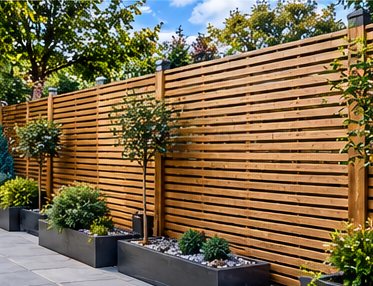
Fence Height and Boundary Rules in England: What to Check First
What to check before fitting or replacing a boundary fence in England: height limits, ownership, neighbours, slopes and access.
Read the guide
Fence Posts: Concrete, Timber or Metal and How They Are Fixed
How fence post material and fixing method affect strength and lifespan, with advice on depth, drainage, slopes and gateposts.
Read the guidePlanning fencing?
Send a few details and we will arrange a free site visit. Photos on WhatsApp help us understand the job before we visit.
Get a free quote
Tell us a little about the job and we will come back to you shortly.