
Driveway Edging, Kerbing and Steps: Getting the Edges Right
Why driveway edges fail, which kerb types to consider, and how to handle steps, ramps, thresholds and drainage at the entrance.
When a block paved or resin driveway starts to fail, it usually starts at an edge. The blocks nearest the boundary spread, the surface dips beside a wall, or water runs into the garage because the threshold was set a touch too low. The middle of a drive tends to look after itself; the edges are where the details matter.
This guide covers edge restraints, the main kerb options, why edges let go, and the awkward spots: steps, ramps on sloping drives, the garage door threshold and the point where your drive meets the road. Getting these right is a large part of what separates a drive that lasts from one that needs repairs.
Why every driveway needs a firm edge
Block paving works because the blocks are held tightly together by sand in the joints and by something solid around the perimeter. Take that perimeter away and the blocks gradually creep outwards under traffic, the joints open, and the surface loosens. The same is true of resin and gravel systems: an unsupported edge breaks up or spills.
The restraint can be a house wall, a boundary wall, a kerb, or a concrete haunching that locks a row of edge blocks in place. What matters is that it is set on solid foundations and bedded on concrete, not just pushed into loose soil. Along a lawn or border, a restraint also stops soil and turf from creeping onto the paving.
Think of the edge as part of the structure rather than a finishing touch. If you are laying new paving beside an old wall, check the wall's foundation too, because a restraint is only as sound as whatever it leans on. Where a drive runs alongside a flower bed, a buried edge also stops soil washing across the surface and staining it after heavy rain.
Kerb types and where they suit
Kerbs on a drive are not all the same product. Some are heavy, formal and durable; others are light, decorative and meant to separate rather than restrain. Choose according to the load at that edge, not just the look.
- Concrete kerbs: the common, dependable choice for restraint, available in several profiles, including bullnose and half-batter.
- Granite kerbs: very durable and handsome, a good fit for traditional houses or where a high-end finish is wanted, but heavier to handle and slower to lay.
- Block edging: a row of paving blocks laid as a soldier course, bedded on concrete; this gives a neat matching finish for a modest load.
- Small decorative edgings: fine for dividing gravel from lawn, but not a substitute for a proper restraint on a trafficked edge.
Why edges fail
The usual culprit is a restraint that was never properly built: no concrete bed, no haunching at the back, or a kerb dropped onto compacted soil. Over time cars pull at the edge, frost and rain loosen the ground, and the kerb tilts. Once one section moves, the blocks beside it follow.
Other causes are tree roots pushing under an edge, water running beneath the paving because there is nowhere for it to go, and heavy vehicles regularly clipping a corner. The cure is rarely a quick repoint. A sound repair usually means lifting the affected blocks, rebuilding the restraint on proper concrete and relaying.
Steps and ramps on sloping drives
If the drive slopes up or down from the road, the usual aim is to make the slope even and gentle rather than breaking it into steps. A single smooth gradient is easier for cars, pushchairs and bins. Where there is a significant change in level between the highway and a door, a combination of a gently sloping drive and a short flight of steps beside it often works better than forcing one steep ramp.
Steps beside a drive should have an even rise and a comfortable depth to each tread, a non-slip surface, and drainage so water does not sit on them. A handrail is worth considering where the drop is more than a step or two. Keep the drive surface and any steps clearly separated, so a wheel never catches a step edge.
On any slope, think about the transition points as well as the gradient. A sudden change in angle, for example where the drive meets the pavement, can ground a low car or make a bin awkward to wheel. Easing the change over a longer distance, even if it takes extra groundwork, is nearly always worth the trouble.
Garage thresholds and the highway edge
At the garage door, the finished drive should fall slightly away from the building so water runs towards a drain or channel rather than under the door. A drain slot or channel drain just in front of the threshold is a common safeguard where the drive slopes towards the garage and cannot be re-profiled. Keep the finished level below the damp proof course of the house, so that the surface never bridges it.
At the road end, the drive meets the pavement and often a dropped kerb. The highway authority controls the dropped kerb and the pavement crossing, and work on the public part needs its approval, so check with your local council before anything is changed there. Your own land should be finished so that it does not shed loose material or surface water onto the footway.
Drainage at the entrance
Water has to go somewhere, and the entrance is the natural low point of many drives. Falling the surface gently towards a lawn, border or soakaway keeps rainwater on your property in a controlled way; this also helps with the planning rules for paving over front gardens, where permeable surfaces or drainage to a lawn or border within the property are treated more favourably. Check with your local council if you are unsure.
A channel drain across the entrance catches runoff before it reaches the pavement and keeps gravel, soil and silt from washing out. It needs regular clearing, so keep the grating accessible. We handle the groundwork, drainage, laying and finishing ourselves, and we are happy to look at levels and edges during a free site visit.
- Fall the surface away from the house and garage.
- Use a channel drain where water would otherwise run into a garage or onto the pavement.
- Direct runoff to a lawn, border or soakaway where possible.
- Keep gratings clear of leaves and grit.
Common questions
Do I need a kerb around my block paved driveway?
Every block paved drive needs a restraint on all sides, but it does not have to be a kerb. A wall, a bedded and haunched row of edge blocks or a concrete kerb can all do the job if built on a solid foundation.
Why has the edge of my driveway started to spread?
Usually the edge restraint was not bedded on concrete or has lost its support from behind, so blocks are creeping outwards under traffic. Repair normally means rebuilding the restraint and relaying the affected area, not just topping up the joints.
Can I change the dropped kerb at the end of my drive myself?
No. The dropped kerb and the pavement crossing belong to the highway, and work there needs consent from the highway authority. Check with your local council first, as it normally has to be carried out by an approved contractor.
Keep reading
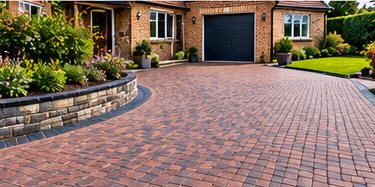
How a New Driveway Is Built: A Clear Step-by-Step Guide
The full build sequence for a new driveway, from site assessment through sub-base to finishing.
Read the guide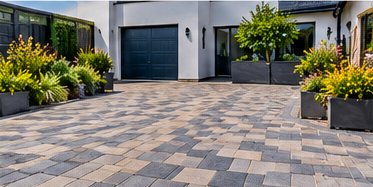
Sunken Block Paving: Causes, Repairs and Aftercare
Why block paving sinks, how repairs are done, and when to replace instead of patching.
Read the guide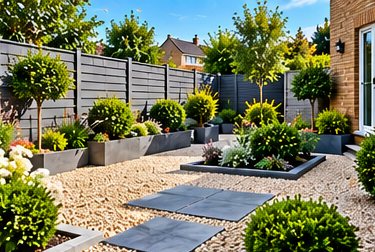
Garden Drainage Solutions: Soakaways, Drains and Channels
Surface water causes, channels, French drains, soakaways and permeable paving, and where water should go.
Read the guidePlanning driveways?
Send a few details and we will arrange a free site visit. Photos on WhatsApp help us understand the job before we visit.
Get a free quote
Tell us a little about the job and we will come back to you shortly.