
Removing Old Sheds, Decking and Patios: A Safe Approach
How to take out old sheds, decking and patios: safety checks, rubble disposal, access and what the ground looks like afterwards.
Taking out an old shed, a rotten deck or a cracked patio looks like a simple demolition job until you start. Hidden hazards, heavy materials, awkward access and what lies underneath can all turn a weekend task into something much bigger. A little planning beforehand avoids most of the surprises.
This article explains how each structure is typically removed, what to check before you begin, how the waste is handled and what the ground looks like afterwards. It also flags where to stop and ask for specialist help, particularly with older materials that may contain asbestos.
Before you start: checks that matter
Look first, then lift. Check for services and drains running near or under the structure, including electricity feeding a shed, water pipes, gas lines, drain covers and inspection chambers. If there is mains electricity to a shed or summerhouse, have it disconnected safely by a qualified electrician before any demolition. If you are unsure what runs where, find out first.
Think about boundaries and neighbours as well. Work close to a fence or wall can disturb it, and noise and dust affect people next door. Wear gloves, eye protection, sturdy boots and a dust mask, especially when breaking concrete.
Dismantling sheds and outbuildings
A timber shed usually comes apart in reverse order of building: remove the contents, then the door and windows, the roof covering, the roof frame, the walls and finally the floor and base. Many sheds are fixed with long nails and screws, so a crowbar, claw hammer and drill with a screwdriver bit help.
The roof is where caution matters. Older sheds, garages and outbuildings with corrugated or flat panel roofing, or cement sheets, may contain asbestos. Do not break, drill, saw, sand or power wash these. If you suspect asbestos, leave it alone and seek a specialist or contact your local council about safe removal. Newer felt-covered timber roofs can be stripped and bagged as ordinary waste, but check first.
- Empty the shed and check for wasps, rodents and hazardous items.
- Disconnect any electricity through a qualified electrician.
- Remove the roof covering before the frame, and treat suspect sheet roofing as asbestos until proven otherwise.
- Pull nails or bend them flat as you go, and keep sharp offcuts bagged.
- Check what the base is made of, as it may be slabs, concrete or timber bearers.
Taking up old decking
Decking is generally lifted board by board, starting at one end. Boards are screwed or nailed to joists, and the fixings are often rusted. A cat's paw, claw hammer and impact driver all help. Boards that look sound can snap suddenly, so test as you go, and watch for protruding nails because they cause a lot of injuries.
Once the boards are off, look at the frame. Rotten joists, posts and bearers are common, especially where timber has lain against damp ground. Underneath you may find a weed membrane, gravel or bare soil, usually damp and sometimes with a lot of debris. If the deck is raised, check that the structure is safe before climbing over it, and take it apart in sections.
Pay attention to how the deck is attached to the house. Ledger boards bolted to a wall may need care to avoid damaging brickwork or the damp-proof course, and holes should be filled and sealed once the board is off.
- Work from the edge inwards, removing boards before joists.
- Wear gloves, as splinters and rusty fixings are the main hazards.
- Pull or hammer flat every nail and screw head.
- Treated timber should not be burned, so plan to take it to a proper disposal point.
Breaking up old patios, paths and concrete
Slabs laid on sand and a few spots of mortar can often be lifted whole with a bolster chisel and pry bar, which keeps them reusable. Paving laid on a full mortar bed, and concrete, needs breaking up with a lump hammer, breaker or a mini digger. Concrete often has mesh or reinforcing bar through it, which complicates the job.
Breaking concrete is hard, dusty and heavy. Hire equipment only if you are confident using it, and note that dust from cutting or breaking concrete should not be inhaled. For larger areas, a machine with a breaker attachment does the work in a fraction of the time, though it needs space to operate.
Wear ear defenders and a dust mask when breaking concrete, and wet the surface lightly to keep dust down. Keep children and pets well away from the working area.
Rubble, timber and disposal
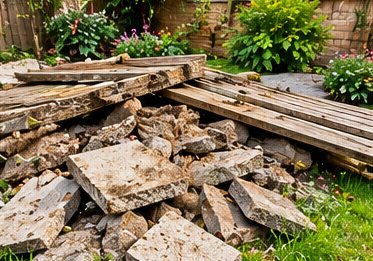
Hardcore, broken concrete and paving are heavy and are easier to deal with when kept separate and clean, as they can often be recycled. Timber should be separated from rubble, and treated or painted timber should not be burned. Keep metal fixings, mesh and felt separate where you can. Check the rules with your local council, and ask any waste carrier for their licence details.
Remember that a skip filled with rubble will weigh far more than the same skip filled with timber. Tell the skip company what is going in so that the size and weight are right. Our article on green waste and garden rubbish disposal covers skips, removal services and sorting in more detail.
Access for machines and barrows
Think about how material will leave the garden. A narrow side passage means everything goes out by wheelbarrow and hand, which takes longer and affects how the job is done. Wider access may allow a mini digger and a tipper, which suits larger patios and concrete bases. Check gate widths, overhead branches and the strength of any surface machines cross, because tracked machines and loaded skips can crack drives and kerbs.
If a machine is used, protect lawns and paths with boards and agree where the skip will stand before work begins.
Plan the order of work so the skip goes where the heaviest material will be produced, and so you are not carrying rubble through a house or over a lawn you wish to keep.
What the ground looks like afterwards
Expect bare, rough ground. Under a shed there is often a worn, level area of compacted soil with possible concrete or slab remnants. Under a deck, the soil can be damp, weedy or covered in debris. Under a patio, you will usually find a compacted sub-base of hardcore and sand that may be worth keeping if you are laying something new.
Before replacing the surface, check levels, drainage and whether the ground needs to be dug out or topped up. We can look at the site during a free site visit and advise on what is needed for the next stage, whether that is a lawn, new patio or planting.
Common questions
Is it safe to remove a garage or shed roof with asbestos?
Not as a DIY job. Do not break, drill or cut suspect asbestos sheets, and instead speak to a specialist or your local council about safe removal.
Can I burn old decking and shed timber?
Treated, painted or varnished timber should not be burned, and bonfires can upset neighbours or break local rules. Check with your local council and take unwanted timber to a proper recycling or disposal point.
Will old paving be reusable?
Slabs laid on sand can sometimes be lifted carefully and reused, but those bedded in mortar often break. Concrete is usually broken up and recycled as hardcore.
Keep reading
Overgrown Garden Clearance: How the Job Is Done Step by Step
A practical walk-through of how a neglected, overgrown garden is assessed, cleared, sorted and left ready for its next stage.
Read the guide
Clearing and Preparing a Garden Before Landscaping Starts
Strip-out, excavation, levelling, drainage and sequencing: the preparation that decides how a new patio, driveway, lawn or fence turns out.
Read the guideGreen Waste and Garden Rubbish Disposal: Your Options
How to sort and dispose of green waste, soil, rubble and general garden rubbish responsibly, and when to hire a skip or a removal service.
Read the guidePlanning garden clearance?
Send a few details and we will arrange a free site visit. Photos on WhatsApp help us understand the job before we visit.
Get a free quote
Tell us a little about the job and we will come back to you shortly.